

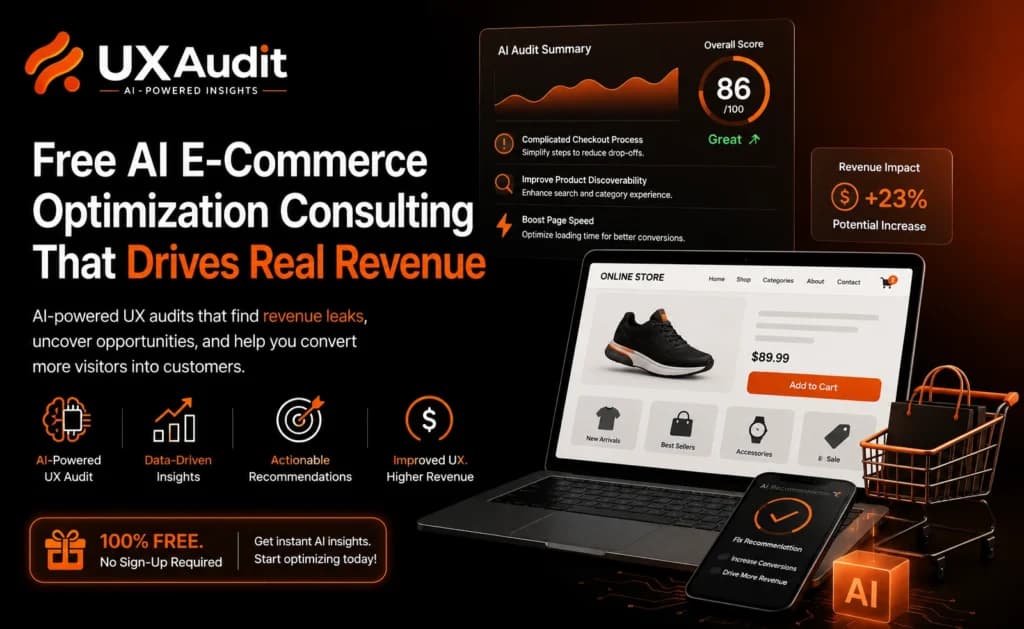

Most online store owners have been told they need expensive consultants to fix what’s broken in their sales funnel. That was true five years ago. In 2026, a growing number of AI-powered platforms offer free e-commerce optimization consulting that actually drives real revenue, not just pretty reports that collect dust. The catch? Most business owners don’t know these resources exist, or they’ve been burned by “free” offers that turned out to be glorified sales pitches. I’ve watched dozens of Shopify, WooCommerce, and BigCommerce stores go through free AI audits over the past two years, and the results split cleanly into two camps: stores that gained nothing and stores that found five-figure revenue leaks in under an hour. The difference wasn’t luck. It was knowing which tools deliver genuine insight and which ones waste your time. This piece breaks down exactly where the real value lives, what AI can actually diagnose for free, and how to turn those findings into money without spending a dime on retainers.
The Evolution of AI E-Commerce Optimization Consulting
Five years ago, hiring an e-commerce consultant meant paying $5,000 to $15,000 for a human to manually audit your store, pull data from Google Analytics, and hand you a PDF full of recommendations. Some of those recommendations were brilliant. Many were generic best practices copy-pasted from one client to the next. The fundamental problem was scale: a human consultant could only analyze so many data points before the engagement became unprofitable for them.
AI changed that equation completely. By 2024, machine learning models could ingest an entire store’s behavioral data, transaction history, and product catalog in minutes. By 2026, several platforms offer this analysis at no cost, monetizing through premium tiers or partner integrations instead. The consulting model flipped from “pay for diagnosis” to “diagnosis is free, pay for implementation.”
Why Traditional Audit Methods Fail in Modern Markets
A human consultant reviewing your store in 2026 faces a problem that didn’t exist in 2020: the sheer volume of customer touchpoints. Your shoppers arrive from TikTok, Google Shopping, email, SMS, organic search, and referral links. They browse on phones, tablets, and desktops. They interact with chatbots, read reviews, compare prices on three tabs simultaneously, and sometimes abandon carts just because their bus arrived.
No human can track all of these micro-interactions and identify patterns across thousands of sessions. Traditional audits rely on aggregate metrics like overall conversion rate and average order value, which hide the specific moments where revenue disappears. A store might have a 2.8% conversion rate overall, but AI analysis often reveals that mobile users from paid social convert at 0.4% while desktop organic users convert at 7.1%. That gap represents a specific, fixable problem that aggregate numbers completely mask.
The Shift from Generic Advice to Data-Driven Execution
The old consulting playbook was predictable: improve your product photos, write better descriptions, add trust badges, speed up your site. All valid advice, but none of it was personalized. AI-driven consulting flips this by starting with your actual data rather than industry templates.
Free AI tools from platforms like Triple Whale, Octane AI, and newer entrants like StorePilot now analyze your specific store and tell you things like: “Your customers who buy Product A within 48 hours of their first visit have a 340% higher lifetime value than average, but you’re not targeting this segment in any campaign.” That’s not generic. That’s a revenue instruction manual built from your own numbers.

Identifying High-Impact Revenue Leaks with Free AI Analysis
Revenue leaks are the silent killers of e-commerce profitability. Most store owners focus on driving more traffic when the real problem is that 96% of their existing visitors leave without buying. Free AI analysis tools have gotten remarkably good at pinpointing exactly where and why money slips through the cracks.
The best free tools don’t just tell you your bounce rate is high. They show you that visitors who view three or more products but don’t add to cart are getting stuck on your size guide page, or that your shipping cost reveal on the cart page causes a 41% drop-off compared to stores that show shipping earlier.
Automated Conversion Rate Optimization (CRO) Assessments
Several platforms now offer free CRO assessments powered by AI that go far beyond basic heuristic checks. Tools like Google’s own AI-powered site analysis, Hotjar’s free tier with AI session analysis, and Shopify’s built-in store optimization recommendations can identify friction points without you hiring anyone.
Here’s what a solid free CRO assessment should cover:
- Page load performance correlated with actual conversion impact, not just speed scores
- Cart abandonment patterns segmented by traffic source, device, and time of day
- Product page element analysis: which images, descriptions, and review formats correlate with higher add-to-cart rates
- Checkout flow friction: where users hesitate, backtrack, or leave entirely
The key difference between useful and useless free assessments is specificity. If a tool tells you to “improve your checkout experience,” that’s worthless. If it tells you that adding a progress indicator to your three-step checkout could reduce abandonment by 12-18% based on similar stores’ data, that’s something you can act on today.
Predictive Analytics for Customer Lifetime Value
This is where free AI consulting gets genuinely exciting. Predictive CLV models used to require a data science team and months of work. Now, platforms like Klaviyo and Retention.com offer free tiers that predict which first-time buyers are likely to become repeat customers and which ones will never return.
Why does this matter for revenue? Because most stores spend the same acquisition cost on every customer, regardless of their predicted value. If AI tells you that customers who buy from a specific product category and live in certain zip codes have a predicted CLV of $420 versus your store average of $85, you should be willing to spend four times more to acquire those customers. That single insight, available for free, can reshape your entire ad budget allocation.
Personalization Strategies That Scale Sales
Generic shopping experiences are revenue poison in 2026. Consumers expect stores to know what they want, and AI makes that possible even for small operations running on tight budgets.
Dynamic Product Recommendations and Bundling
Free AI recommendation engines have matured significantly. Shopify’s native AI recommendations, WooCommerce plugins like Sales Booster AI, and standalone tools like Barilliance’s free tier can analyze purchase patterns and browsing behavior to suggest products that individual shoppers are statistically likely to buy together.
The numbers here are hard to ignore. Stores implementing AI-driven product recommendations typically see a 10-30% increase in average order value. One DTC skincare brand I followed added AI bundling suggestions to their product pages using a free Shopify app and saw their AOV jump from $47 to $62 within six weeks. No paid consulting. No development work. Just a free tool doing what it was designed to do.
The trick is placement. Recommendations on the product page (“frequently bought together”) perform differently than recommendations in the cart (“you might also like”) or post-purchase (“customers who bought this came back for”). Test all three positions, because the winning combination varies by store category.
AI-Driven Email and SMS Retargeting Workflows
Email and SMS remain the highest-ROI channels for e-commerce, and free AI tools have made sophisticated retargeting workflows accessible to everyone. Klaviyo’s free tier supports up to 500 contacts with full AI-powered segmentation. Omnisend offers similar capabilities. These aren’t watered-down versions of paid products: they include predictive send-time optimization, automated win-back sequences, and behavioral triggers.
A well-configured AI email workflow does things no human marketer can do manually: it identifies the exact moment a customer is most likely to repurchase based on their individual buying cycle, crafts subject lines tested against your audience’s response patterns, and adjusts send frequency based on engagement signals. Setting this up takes an afternoon, costs nothing, and typically generates $3 to $8 per contact per month for stores with decent list quality.
Streamlining Operations and Inventory Management
Revenue optimization isn’t just about selling more. It’s about not losing money on the operational side. Overstocking ties up cash. Understocking kills sales. Poor fulfillment timing generates returns. AI addresses all three.
AI Demand Forecasting to Reduce Overstock
Free demand forecasting tools have become surprisingly accurate. Google’s Vertex AI offers a free tier for small datasets, and platforms like Inventory Planner provide free trial periods long enough to generate meaningful forecasts. These tools analyze your sales history, seasonality patterns, and even external signals like weather data and trending search terms to predict demand at the SKU level.
One home goods store I know reduced their dead stock by 34% in one quarter after implementing AI demand forecasting through a free tool. They discovered that three product lines they kept reordering had declining demand curves that their gut instinct completely missed. The AI caught it because it wasn’t emotionally attached to those products.
How to Access No-Cost AI Consulting for Your Store
Finding free AI e-commerce consulting that actually delivers value requires some filtering. The market is flooded with “free audit” offers that are really just lead generation funnels for expensive agencies.
Vetting Free Consultation Offers for Real Value
Not all free offers are created equal. Here’s how to separate the genuine from the garbage:
- Look for tools that deliver specific, data-backed recommendations, not vague observations
- Avoid any “free consultation” that requires a credit card or long-term commitment upfront
- Prioritize platforms that show you the analysis methodology, not just the conclusions
- Check whether the free tier includes enough functionality to actually implement changes, or if every useful feature sits behind a paywall
- Read reviews from store owners in your revenue range: a tool built for enterprise clients won’t help a store doing $20K per month
The best free AI consulting comes from platforms whose business model doesn’t depend on you upgrading. They make money from data partnerships, affiliate integrations, or premium features that genuinely add value beyond the free tier.
Implementing Actionable Insights for Immediate ROI
Getting a free AI audit is step one. Doing something with it is where revenue actually happens. Prioritize recommendations by estimated impact and implementation difficulty. A change that takes 30 minutes and could increase conversion by 0.5% should happen today. A recommendation requiring custom development can wait.
Start with your highest-traffic pages and your most-abandoned checkout steps. These represent the largest pools of recoverable revenue. Track every change with proper attribution so you know what’s working. Most free analytics tools support A/B testing or at least before-and-after comparison.

Turning Free Insights into Lasting Revenue Growth
The opportunity sitting in front of e-commerce store owners right now is genuinely unusual. AI-powered UX audit tools that would have cost thousands in consulting fees just a few years ago are now available at little or no cost, delivering insights that businesses can act on immediately. The stores winning in 2026 aren’t necessarily the ones with the biggest budgets. They’re the ones using AI-driven analysis to identify usability issues, remove friction, and fix revenue leaks faster than their competitors.
Pick one UX audit tool from this article and run your store through it this week. Implement the top three recommendations. Then measure the results over the next 30 days. That single cycle of AI-powered optimization can reveal valuable opportunities to improve customer experience, increase conversions, and strengthen business performance. In many cases, you’ll gain more actionable insights than you would from lengthy consulting engagements, while investing only a few hours of your time.