



Imagine pouring water into a bucket with small holes at its bottom. No matter how much water you pour into it, the bucket will never be full since it constantly leaks through these holes.
This is how many websites work nowadays. Companies spend thousands of dollars on SEO, PPC and social media marketing to get more visitors to their site. However, once these people arrive on your page, you don’t convert them into buyers. And often, the reason for this doesn’t lie in poor promotion but in usability problems on your website that force people to leave your page and go somewhere else.
But before you invest more money in ads, consider this: Do they convert? Usually, the solution to the problem of leakage of conversion will bring you a higher return on investment compared to getting new visitors, which is why ecommerce checkout conversion rate optimisation should precede all other investments in ads. The main issues that prevent people from making purchases online will be revealed in this blog.
The Real Cost of a Leaky Funnel
Anyone who visits your website has already cost you some money, whether it’s a click, a placement in the search results you have been fighting for, or a follower who took months to trust you with their information. So when that visitor decides to leave without making a purchase, you not only lose a sale but also all the marketing efforts used to bring them there.
That is the reason why it is more effective to deal with the conversion issues and improve the conversion rate than to increase the number of visitors. Driving 50 per cent more traffic to a website with a 1 per cent conversion rate will yield about the same revenue as boosting the conversion rate to 1.5 per cent on a steady traffic level.
The Common Culprits: Why Users Abandon Ship
Users do not exit without reason. The hidden UX problems are responsible for friction, eroding trust, and disrupting the customer’s journey on your site.
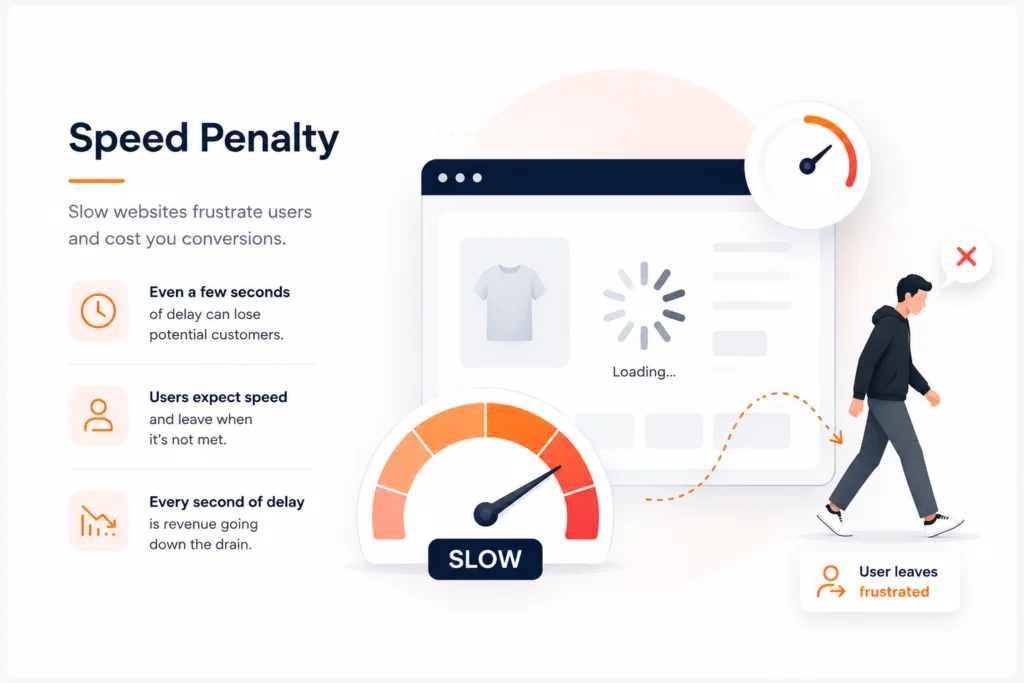
The Speed Penalty: Why Milliseconds Matter
Speed is the hidden leak from your bucket. In an era where everything is instant, a slow-loading page is not just an issue of inefficiency; it’s a clear call to your consumers to leave your website.
A website that lags will cause the users to perceive the website as being unreliable and thus exit the website without even getting started with what they want to do. The visitors expect a seamless process, and any kind of latency ruins the process. The way to stop this leakage is by cutting down the irrelevant scripts and compressing the images.
The Mobile Gap: When Your Site Doesn’t Fit the Pocket
The look of your website may be fantastic when viewed from your computer, but if it fails in the case of a mobile phone, you are basically throwing money down the drain via a big hole at the bottom.
Your audience is mobile by nature, and they will neither pinch, zoom, nor try to navigate through a website that does not take their gadget into consideration. It would irritate them that the button sizes do not allow tapping or that text prompts them to use horizontal scrolling to read it.
The Misleading Signposts: When your path to purchase isn’t clearly marked
Imagine shopping in a store without aisles marked and checkout counters veiled behind curtains. Chances are you’ll walk out simply because of your frustration. The same thing happens on your website. If your “Add to Cart” button or “Buy Now” button does not stand out among other content or if your navigation system is confusing, then you are making it hard for yourself.
Customers do not need to be looking for the next thing to do – they need to be encouraged to buy. To stop this leak, make your buttons and navigations high in contrast and clear in direction.
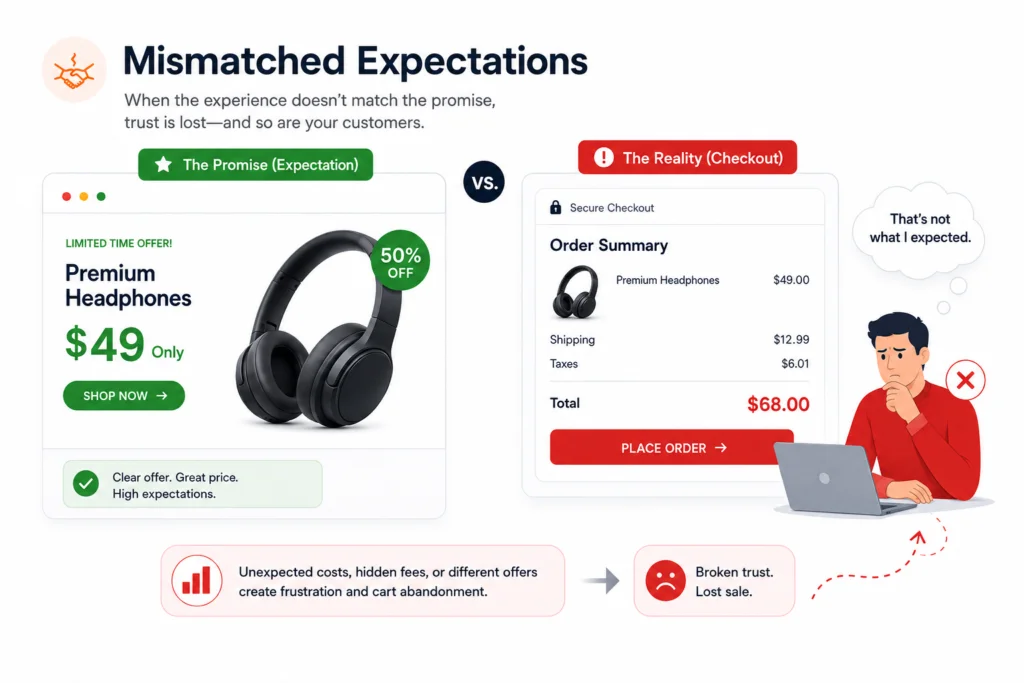
Mismatched “Expectation Reality
This is “bait and switch” in the digital age. It refers to the discrepancy between the commitment made through your marketing process—in terms of discounts, features, or the total cost—and what the consumer experiences when they reach the payment page.
An inaccuracy of even the slightest sort—a product price without taking into consideration service charges functions as an instant trust breaker. You instantly go from being a credible seller to an untrustworthy one in their eyes. This results in them dropping the shopping cart and leaving.
Hidden Time-Pressure
It is common practice to apply urgency through the use of scarcity methods. However, such signals can be counterproductive when they turn out to be manipulative, making visitors doubt rather than purchase products.
For example, a timer that starts over after page refreshment, or a “limited stock” message that disappears at checkout, destroys the illusion of urgency. Such practices not only show disrespect to visitors but also reveal that your business values coercion rather than honest dealing. Urgency can be a good marketing method; however, manipulations that try to make visitors act in haste destroy any chances of converting them into clients.
How a UX Audit Fixes These Problems
These problems do not often introduce themselves in such a manner. The visitor does not give any explanation for leaving his shopping cart empty; he simply leaves. Conducting a UX audit is how one turns this silence into insight. This often includes several techniques:
Heatmaps and click tracking
The heat map and click tracking can help identify where the user is really looking, what he or she finds difficult, and where the necessary buttons may not be noticed, or where clicking occurs on irrelevant objects.
Session recordings
The session recordings provide true-to-life mouse movements and clicks; you can observe how and when the visitor is hesitating on one or another item, returning or leaving the page, which was previously invisible to your eyes.
Funnel Analysis
The funnel process analyses how users move from one stage to another in the checkout process, from shopping cart to shipping to payment, to understand at precisely which point there is maximum drop off, and thus address that particular aspect which is driving the customer away, rather than making assumptions about what the problem area may be. This is the underlying concept behind all ecommerce checkout conversion rate optimisation in ecommerce. For a deeper look at spotting these opportunities across the entire customer journey, not just checkout, see how to find revenue opportunities hidden in your customer journey.
Heuristic evaluation
Heuristic evaluation is when a user experience specialist analyses your website using well-known principles of usability, such as consistency, feedback, error prevention, etc., revealing those obstacles which may not be visible through the analysis of statistics, because some flaws may appear first, even before you see them in the data.
Audit Your Website For Free With Our Ux Audit Tool
Don’t keep guessing where your users are getting lost. Conduct a free audit through UXAuditTool.com to see clearly into your usability weaknesses that are silently draining your money – no credit card required, no sales pitch, just an honest assessment in less than three minutes.
Identify UX Issues Before They Cost You Customers, Start your Free AI UX Audit Now