



When discussing growth opportunities, companies tend to talk about traffic generation, marketing budget growth or product innovation. Although these points are crucial, there is one highly profitable resource that companies usually forget about – user experience (UX).
A website that gathers thousands of users yet cannot convert them is constantly losing money. Slow load speed, difficult navigation, complex checkout procedures or vague call-to-actions slowly but steadily repel potential clients from using their services. The majority of companies do not realize such problems unless there is a drop in conversion rates or an increase in customer acquisition cost.
This is exactly why UX has become a business strategy rather than a design approach. Those companies that prioritize the creation of a smooth experience of interacting with their products witness tangible improvement in conversion rates, client satisfaction, retention rate and overall profit.
Here, we will look into what ROI of UX means, how it is related to you, how a bad website UX audit affects your company and what an AI-powered UX audit can do for you.
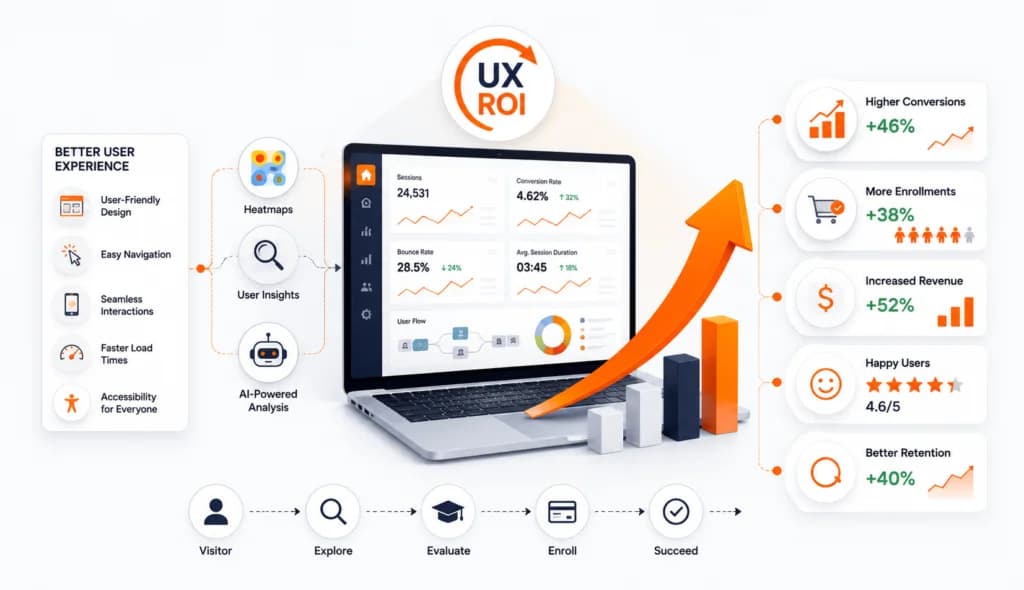
What Is UX ROI?
UX Return on Investment (ROI) refers to the amount of business gained by making changes to the user experience, which would be measured against the cost involved in making those changes.
In contrast to a typical marketing campaign, which demands an ongoing expense, UX changes often provide long-term value. Once any existing friction in your customer experience has been eliminated, all future customers will benefit from the better experience.
Today, most organizations adopt AI to speed up the optimization procedure and make it more data-oriented. Instead of depending solely on manual assessments, audits powered by AI can carry out the search for usability problems, assess usability improvements, and forecast their influence on conversions. If you are interested in this movement.

Some ways businesses calculate UX ROI include:
- Conversion rates
- Average order size
- Bounce rates
- Cart abandonment
- Customer retention
- Fewer support inquiries
- Lifetime Customer Value (CLV)
Rather than having to spend money on additional traffic, UX makes you more effective at converting your current traffic.
Why User Experience Directly Affects Revenue
Every interaction on your website is an opportunity for the user to make a choice.
Consider an online buyer visiting your website. He finds the required product but cannot find any information regarding the shipping process. Your checkout requires unneeded information from the customer. The payment page loads slowly.
None of those seem like critical flaws separately.
All of them create reasons for the user to go away together.
Bad UX creates friction during the customer’s journey, and each additional click, delay, or difficulty adds more chances for abandonment.
Common UX problems that reduce revenue are:
- Slow page load time
- Lack of proper mobile responsiveness
- Complex navigation
- Hidden calls-to-action
- Difficult forms
- Complex checkout process
- Issues with accessibility
- Weak search functionality
- Poor product information architecture
A comprehensive website usability audit helps identify these problems before they negatively impact conversions and customer satisfaction.
The Hidden Cost of Poor UX
Most companies don’t fully appreciate how costly bad UX is.
The costs are not always apparent since visitors do not always state reasons for their departure.
The signs that companies notice include:
- Decreased Conversion Rate : A minor usability problem may make users reluctant to go through with transactions or sign up through leads.
- Higher Cost Per Customer Acquisition (CAC) : When there is a low percentage of converted visitors, companies need to allocate more resources to get the same number of customers.
- High Bounce Rates : Visitors will quickly abandon a website if they find it unsatisfactory to their expectations or complicated to use.
- Increased Customer Support Inquiries : A confusing layout causes inquiries about various aspects of orders, payments, refunds, and account maintenance.
- Less Customer Loyalty : Customers won’t forget bad experiences; they prefer easier competition.
This combination of inconspicuous expenses becomes a noticeable loss of profit.
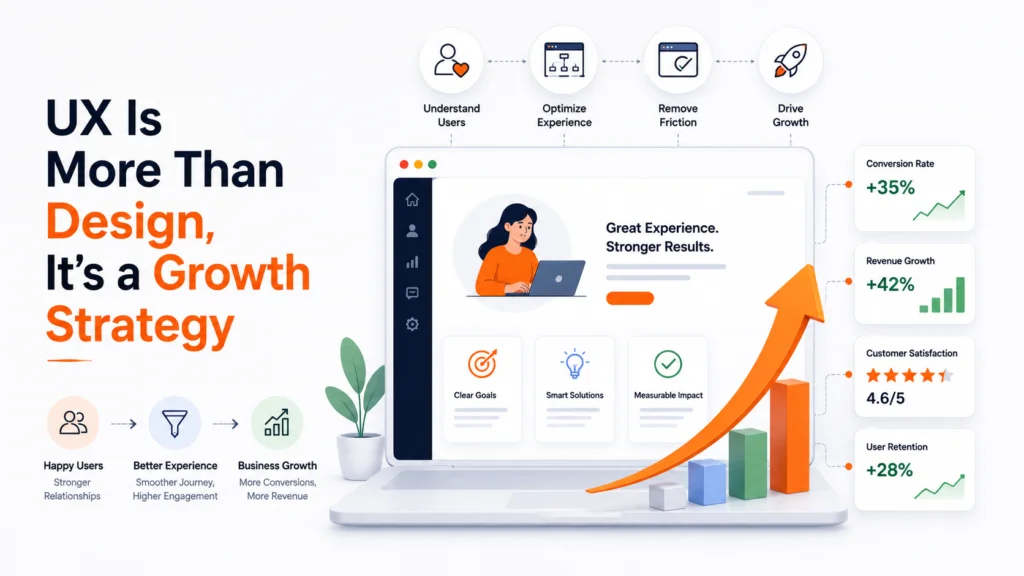
UX Is More Than Design, It’s a Growth Strategy
Many companies assume that UX is only about creating an appealing website.
In fact, good UX should allow the user to achieve his objective with minimum effort.
The right UX design will enhance:
- Credibility : A professional and intuitive interface adds to the credibility instantly.
- Decision-Making : Effective designs make it easier for users to navigate around your website.
- Task Fulfillment : Be it registration, a request for a demo, or purchasing, users face lesser hurdles.
- User Satisfaction : Good user experience inspires loyalty and recommendations.
When it becomes easy for users to achieve their objectives, it makes them your customers.
Measuring the ROI of UX
In contrast to branding or awareness campaigns, the effectiveness of UX enhancements can be gauged using business KPIs. Comparing your KPIs before and after your UX change will give you an idea of the return on your investment.
- Conversion Rate : This metric indicates what percentage of your site’s visitors perform a certain desirable action. This could be filling out a form or making a purchase.
- Bounce Rate : It shows what percentage of visitors leave your site after having viewed only one page. A low bounce rate usually means a higher engagement level on your site and its overall intuitiveness.
- Cart Abandonment Rate : Measures how many users leave without completing the transaction. A better checkout process can decrease the abandonment rate and boost sales.
- Average Session Time : This refers to the length of time the users spend on the website. A longer average session usually means that the users find the information on the site useful and easy to use.
- Customer Retention Rate : Represents the number of returning customers. Providing a good user experience increases the likelihood of customer retention.
- Revenues Per Visitor (RPV) : Measures the amount of revenue produced by each visitor on the website. This measure can be easily improved through UX design without attracting any extra visitors.
Discover Hidden Revenue Opportunities with a Free AI UX Audit
Enhancing user experience need not necessarily start with conjecture.
Website UX Audit Tool allows companies to detect friction on websites, measure website performance in terms of 15+ UX and conversion KPIs, assess lost revenue potential, and get prioritized recommendations within a matter of minutes—all without the need for extensive audits and complicated setups.
Whatever your website type – whether eCommerce, SaaS or services-related, learning about the issues your customers face is the first step towards driving conversions and achieving better ROI.
Wanna know how your website stacks up? Conduct an AI-powered UX audit for free!