

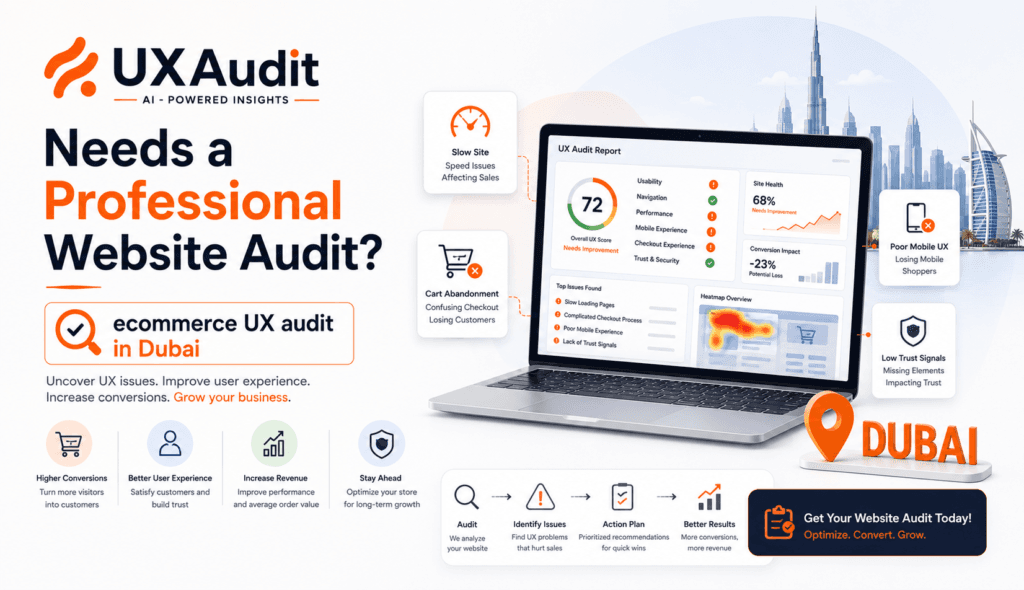

The ecommerce sector in Dubai is doing well and growing. The time between Ramadan racing and White Friday sales means that customers are used to having a perfect experience, whether they are shopping on their phone in a car or on their workstation in the office. The fact is that if your website takes 11 seconds to load or if your checkout process is bad, you are losing customers every day.
Those who are experiencing problems with making sales must consider getting the most professional ecommerce UX audit in Dubai, as it is better than merely hoping for sales; it is a guarantee of data-driven success. An audit of this type is not a luxury or decoration, but it is a how-to guide for conducting a successful business.
Dubai Shoppers Are a Different Kind of Demanding
Dubai is known to be one of the most competitive, high-intent ecommerce markets due to several factors that are not present elsewhere:
It is predominantly mobile-oriented
In fact, a significant proportion of online shopping in the UAE occurs through smartphones while people are on the road. Hence, an ecommerce website that is designed primarily for desktop users, such as using small click targets, slow-loading banners, and forms requiring manual entry, surely has little chance of succeeding.
It is truly multilingual and multicultural.
The shop that caters to Dubai is catering to local Emiratis, to a sizeable community of expatriates from South Asia and Europe, and to tourists who stay for a short time, often for just a day. Shop formats that operate on English-only, left-to-right, and single-currency basis quietly alienate a substantial part of the public even before they reach the product page.
The market relies heavily on trust.
It is common to find cash-on-delivery payment options, return policies are carefully examined, and customers are dropping out of a website that they feel is not trustworthy. In this market, trust signals like transparent policies, published contact details, and safe payment reminders are more productive than in more developed markets where customers are used to shopping online.
It is extremely competitive.
There are numerous competitors in the global marketplace, regional suppliers, and a growing number of local brands are present in the market. A website without a clear message or complicated category structure is doomed to fail.
None of this shows up by staring at a homepage and guessing what looks “off.” It shows up when you systematically test the site the way a real Dubai shopper actually uses it.

What a Website Audit Actually Uncovers
An effective UX and conversion audit goes beyond just looking at visuals and gets into the processes that determine whether someone will make a purchase or not:
- Page speed and performance: on mobile devices are both important factors in a field where most of the Internet traffic is mobile, not desktop.
- Frictions at checkout: every field you add, every account creation step, and every unclear shipping price act as an obstacle
- Navigability and search: can the shopper arrive at a product they sought and understand it in the context they expect?
- Signals of trust and credibility: payment methods, return policy information, contact information, security indicators
- Missing localization: showing the correct currency, right-to-left languages if Arabic is an option, region-specific images and copy
- Funnel leaks: at which precise point do visitors leave the site before completing a purchase
Most site owners can sense that something is wrong when traffic is decent, but sales aren’t. An audit replaces that vague sense with a specific, ranked list of what to fix first.
What A Website UX Audit Uncovers
Website User Experience (UX) Audit by professionals is a diagnosis for the online store. Rather than being based on personal likes or gut feel, it gives an objective assessment of the reasons behind your visitors becoming (or failing to become) your customers.
The following is an overview of the information that can be revealed through the audit, sorted by categories:
1. Performance & Technical Friction
The majority of site visitors will leave a page if it does not have an extremely quick load time. An audit finds out:
Bottlenecks: Detecting pictures that are a big size, having redundant scripts, and finding out server-side delays that lead to troubles for mobile users on 4G/5G networks.
Layout Instability: Repairing elements that are moving around on the page when it loads, which can make users click something by mistake, creating frustration for them.
Mobile Responsiveness: Detecting the failure points on a website during the transition from desktop to mobile. Examples of such failings are text being too tiny, buttons being too difficult to push with a thumb, and menus that are not visible.
2. Issues in the Conversion Funnel
The audit identifies the specific point where revenue is being lost:
Problems at checkout: Detecting “form fatigue,” or unnecessary fields, confusing address fields, or costs that are revealed too late in the process.
Causes of abandonment: Understanding why customers drop off at the cart stage or during payment (lack of preferred local payment options, vague shipping information, or “surprise” taxes or fees).
Micro-conversion hindrances: Verifying whether customers interact with “Add to Cart,” “Sign Up,” or “View Product” buttons successfully or whether these elements are poorly designed.
3. Usability & Information Layout
If the user is not able to locate something, he or she will not make any purchases. An analysis checks:
Search Efficiency: Examining whether the in-house search is successful in generating useful results, or it has too many instances of its “no items found” result.
Structured Ordering: Assessing whether the product classification is easy for the visitor or if it is mistakenly overcomplicated by layers of categories.
Noticeable Calls to Action: Making sure that the next steps for the user are simple, clear, and encouraging enough.
4. Trust & Credibility Issues
In high-intent environments such as the UAE, trust plays a vital role in making the final purchase decision.
Missing Trust Signals: The absence of certain signals, such as easily noticeable return policy statements, safe transaction logos, information on ways of contact, and confirmation of credibility (presence of customer reviews).
Consistency Errors: Finding the inconsistencies in the elements, for example, milled letters, broken links, etc.
5. Accessibility (Compliance with WCAG Standards)
Through an audit, you can find out whether your site is leaving some of your audience out by looking at:
Visual Contrast: Making sure that all the text is visible to impaired users.
Keyboard Usage: Make sure that access to your site doesn’t require a mouse.
Screen Reader Support: Making sure that all the images and buttons on your site have appropriate “alt-tags.”

Don’t Let Friction Kill Your Conversions
There is no need to speculate how to retain customers. Every moment it takes for the website to load and every slow step during the checkout process is what is called “friction tax” and is equivalent to giving your money to rivals.
For more information about the problem and more reasons for cart abandonment, please take a look at our blog “Why Your Website Is Losing Customers Before They Reach Checkout”
You should stop letting design issues stop you from generating profits from your constant streams of customers. It’s time to start making money from your marketing investment. Get in touch with us now to receive the top ecommerce UX audit service in Dubai.

FAQs
- What is the duration of website audits conducted by professionals?
Generally, the entire process spans 7 to 14 days and results in a prioritized action plan customized based on the requirements of the particular client. - Will an audit really help boost my sales figures?
Yes, through systematic elimination of obstacles to conversion and boosting trust indicators, you will directly enhance the customer experience and improve sales.